


Contact


Reuse
The return rate drives productivity
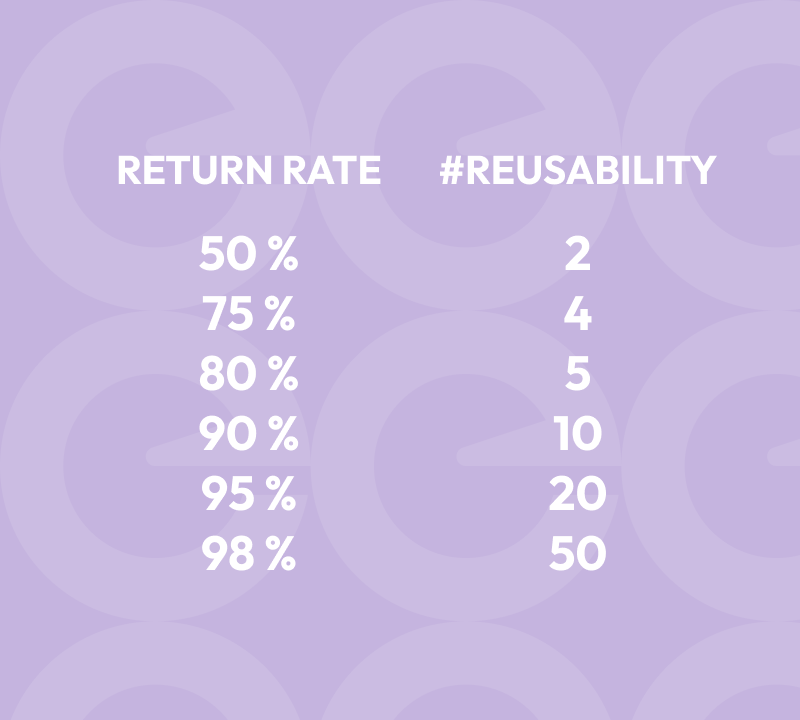
Produce once, maximize reuse = one-time production costs, "only" collection and service costs thereafter. This is why the return rate (rr) is not only ecologically but also economically decisive: the higher the return rate, the more productive the packaging. The faster the cycle, the faster packaging-as-a-service can be billed again.
Packaging design for reuse
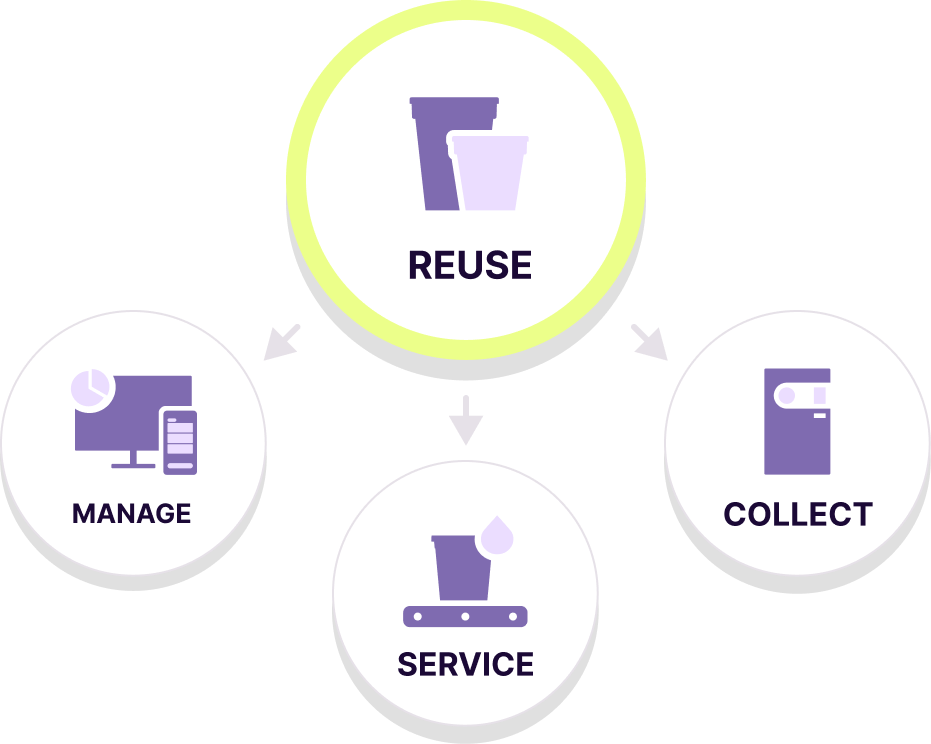
To achieve simplicty for all stakeholders within a reuse system, reusable packaging must meet the requirements of any targeted category AND the other three value domains. A coffee cup must work for the category coffee and the reusable packaging system, packaging for FMCG-foods must work for the respective categories and the reuse system. Since the system requirements of the value domains must be considered in packaging design, the ‘Reuse’ value domain is system-shaping.

Reuse as a system-shaping value domain
The design of reusable packaging is not an isolated design or product decision for reuse in a given category. Packaging design sets the physical, operational and economic framework for the entire reuse system.
Material choice, form factor, durability, standardisation, and code placement determine how easily return, care and management are possible within the system. If a reusable package is not designed to be system-compatible, complexity and costs inevitably shift to the other value domains.
Requirements of all value domains for packaging design
Requirements from COLLECT – Return Network
Packaging design defines how easily packaging can be recognised, returned and collected. Standardisation, robustness and clear identification are prerequisites for high return rates and convenient collection processes.
If packaging does not meet these requirements, return barriers increase — and with them system costs and losses.
Requirements from SERVICE – Pool Care
Packaging design determines sorting effort, cleanability and pool lifespan. Complex materials, poorly separable components or low durability increase service costs and shorten the usage cycle.
Packaging design thus directly determines the economic viability of service operations.
Requirements from MANAGE – Pool Management
Packaging design determines how well packaging can be captured, tracked and managed within the system. Clear identification and cycle stability are prerequisites for reliable inventory management, billing and partner coordination.
Without packaging design capable to be managed, system control becomes fragmented or manual.
Systemic Classification
These requirements show why reusable packaging design cannot be optimised without also considering the value domains Collect, Service and Manage — and why the Reuse value domain plays a system-shaping role in the Operating Model.

Continue to the value domains



Contact
Reuse
The return rate drives productivity
Produce once, maximize reuse = one-time production costs, "only" collection and service costs thereafter. This is why the return rate (rr) is not only ecologically but also economically decisive: the higher the return rate, the more productive the packaging. The faster the cycle, the faster packaging-as-a-service can be billed again.
Packaging design for reuse
To achieve simplicty for all stakeholders within a reuse system, reusable packaging must meet the requirements of any targeted category AND the other three value domains. A coffee cup must work for the category coffee and the reusable packaging system, packaging for FMCG-foods must work for the respective categories and the reuse system. Since the system requirements of the value domains must be considered in packaging design, the ‘Reuse’ value domain is system-shaping.

Reuse as a system-shaping value domain
The design of reusable packaging is not an isolated design or product decision for reuse in a given category. Packaging design sets the physical, operational and economic framework for the entire reuse system.
Material choice, form factor, durability, standardisation, and code placement determine how easily return, care and management are possible within the system. If a reusable package is not designed to be system-compatible, complexity and costs inevitably shift to the other value domains.
Requirements of all value domains for packaging design
Requirements from COLLECT – Return Network
Packaging design defines how easily packaging can be recognised, returned and collected. Standardisation, robustness and clear identification are prerequisites for high return rates and convenient collection processes.
If packaging does not meet these requirements, return barriers increase — and with them system costs and losses.
Requirements from SERVICE – Pool Care
Packaging design determines sorting effort, cleanability and pool lifespan. Complex materials, poorly separable components or low durability increase service costs and shorten the usage cycle.
Packaging design thus directly determines the economic viability of service operations.
Requirements from MANAGE – Pool Management
Packaging design determines how well packaging can be captured, tracked and managed within the system. Clear identification and cycle stability are prerequisites for reliable inventory management, billing and partner coordination.
Without packaging design capable to be managed, system control becomes fragmented or manual.
Systemic Classification
These requirements show why reusable packaging design cannot be optimised without also considering the value domains Collect, Service and Manage — and why the Reuse value domain plays a system-shaping role in the Operating Model.

Continue to the value domains


EN
Contact
Reuse
The return rate drives productivity
Produce once, maximize reuse = one-time production costs, "only" collection and service costs thereafter. This is why the return rate (rr) is not only ecologically but also economically decisive: the higher the return rate, the more productive the packaging. The faster the cycle, the faster packaging-as-a-service can be billed again.
Packaging design for reuse
To achieve simplicty for all stakeholders within a reuse system, reusable packaging must meet the requirements of any targeted category AND the other three value domains. A coffee cup must work for the category coffee and the reusable packaging system, packaging for FMCG-foods must work for the respective categories and the reuse system. Since the system requirements of the value domains must be considered in packaging design, the ‘Reuse’ value domain is system-shaping.

Reuse as a system-shaping value domain
The design of reusable packaging is not an isolated design or product decision for reuse in a given category. Packaging design sets the physical, operational and economic framework for the entire reuse system.
Material choice, form factor, durability, standardisation, and code placement determine how easily return, care and management are possible within the system. If a reusable package is not designed to be system-compatible, complexity and costs inevitably shift to the other value domains.
Requirements of all value domains for packaging design
Requirements from COLLECT – Return Network
Packaging design defines how easily packaging can be recognised, returned and collected. Standardisation, robustness and clear identification are prerequisites for high return rates and convenient collection processes.
If packaging does not meet these requirements, return barriers increase — and with them system costs and losses.
Requirements from SERVICE – Pool Care
Packaging design determines sorting effort, cleanability and pool lifespan. Complex materials, poorly separable components or low durability increase service costs and shorten the usage cycle.
Packaging design thus directly determines the economic viability of service operations.
Requirements from MANAGE – Pool Management
Packaging design determines how well packaging can be captured, tracked and managed within the system. Clear identification and cycle stability are prerequisites for reliable inventory management, billing and partner coordination.
Without packaging design capable to be managed, system control becomes fragmented or manual.
Systemic Classification
These requirements show why reusable packaging design cannot be optimised without also considering the value domains Collect, Service and Manage — and why the Reuse value domain plays a system-shaping role in the Operating Model.

Continue to the value domains

EN
Contact
Reuse
The return rate drives productivity
Produce once, maximize reuse = one-time production costs, "only" collection and service costs thereafter. This is why the return rate (rr) is not only ecologically but also economically decisive: the higher the return rate, the more productive the packaging. The faster the cycle, the faster packaging-as-a-service can be billed again.
Packaging design for reuse
To achieve simplicty for all stakeholders within a reuse system, reusable packaging must meet the requirements of any targeted category AND the other three value domains. A coffee cup must work for the category coffee and the reusable packaging system, packaging for FMCG-foods must work for the respective categories and the reuse system. Since the system requirements of the value domains must be considered in packaging design, the ‘Reuse’ value domain is system-shaping.

Reuse as a system-shaping value domain
The design of reusable packaging is not an isolated design or product decision for reuse in a given category. Packaging design sets the physical, operational and economic framework for the entire reuse system.
Material choice, form factor, durability, standardisation, and code placement determine how easily return, care and management are possible within the system. If a reusable package is not designed to be system-compatible, complexity and costs inevitably shift to the other value domains.
Requirements of all value domains for packaging design
Requirements from COLLECT – Return Network
Packaging design defines how easily packaging can be recognised, returned and collected. Standardisation, robustness and clear identification are prerequisites for high return rates and convenient collection processes.
If packaging does not meet these requirements, return barriers increase — and with them system costs and losses.
Requirements from SERVICE – Pool Care
Packaging design determines sorting effort, cleanability and pool lifespan. Complex materials, poorly separable components or low durability increase service costs and shorten the usage cycle.
Packaging design thus directly determines the economic viability of service operations.
Requirements from MANAGE – Pool Management
Packaging design determines how well packaging can be captured, tracked and managed within the system. Clear identification and cycle stability are prerequisites for reliable inventory management, billing and partner coordination.
Without packaging design capable to be managed, system control becomes fragmented or manual.
Systemic Classification
These requirements show why reusable packaging design cannot be optimised without also considering the value domains Collect, Service and Manage — and why the Reuse value domain plays a system-shaping role in the Operating Model.
